For the fourth year in a row, the Wilkes Center for Climate Science & Policy hosted its climate solutions “Hackathon,” with the attention this year on energy.
The event was once again enhanced by nine visiting French Université Côte d’Azur graduate students and two staff leaders, who traveled from Nice, France, for the second year in a row for the competition.
This year, the teams worked from Friday, Feb. 28, until Saturday morning, Feb. 29, in the Wilkes Center’s shiny new space in the L. S. Skaggs Applied Science Building.
The annual climate solutions hackathon challenges undergraduate and graduate students from any discipline to team up and develop proposals to present in a slide deck within 24 hours.
Amped on innovation
The teams had to define a geographic scope, address access to affordable energy and consider in their solutions the impact of AI on energy use, economic impacts, impacts to vulnerable communities or relevant policy or government structures.
The teams earned more points for innovative, data-driven solutions centered on one of four themes:
- Energy infrastructure and climate resilience
- Accelerating the clean energy shift
- Energy efficiency and smart consumption
- Demand and growth management
In addition, an array of local professionals with expertise in energy topics attended both in-person and remotely to offer guidance and consult with teams on their ideas.
Powered-up presentations
After a total of 12 teams submitted slide decks Saturday morning, the teams had four minutes to pitch their idea and answer questions from the in-person and online audience. Afterward, the audience voted for the best presentation—the “People’s Choice Award.”
The submissions were then reviewed by the Wilkes Center team, who evaluated each entry on their definition and analysis of the problem, uniqueness and innovation of the solution and its feasibility and scalability.
Beyond announcing the top winners, the Wilkes Center is exploring various approaches and partnerships to support all teams that wish to take their ideas to the next stage of commercialization.
The winners are listed below. (Note that two teams tied for second place!)
First place ($3,000 or a visit to Université Côte d’Azur)
Project: S.P.A.R.K.

- Marli Bain (undergraduate, electrical engineering)
- Mahdis Borhani (graduate, metropolitan planning, policy and design)
- Johnathon Rodriguez (undergraduate, electrical engineering)
- Marcellus Serge-Kevin (graduate, electrical engineering from Université Côte d’Azur)
The S.P.A.R.K. proposal tackles a growing problem: America’s power grid is aging, overstressed and increasingly vulnerable to extreme weather. Much of the infrastructure is decades old, and upgrading it can take years and cost billions of dollars. At the same time, rising electricity demand and the shift to renewable energy make the grid more prone to blackouts.
S.P.A.R.K. offers a faster, more affordable alternative. Instead of waiting for massive system-wide upgrades, it installs neighborhood-level energy systems that combine batteries and flywheels, such as those produced by Salt Lake City-based Torus. Batteries help reduce strain during peak demand, while flywheels act like shock absorbers, instantly stabilizing the grid when disruptions occur. Together, they lower the risk of outages and improve reliability.
The proposed program would engage communities directly, allowing households to track local energy use through a mobile app and work together to reduce peak demand, earning financial rewards in the form of energy dividends.
The model is designed to be cost-effective, drawing on successful examples—such as Con Edison’s Brooklyn-Queens Demand Management program—where distributed energy solutions replaced billion-dollar infrastructure projects at far lower cost. By focusing first on vulnerable neighborhoods, S.P.A.R.K. aims to improve reliability, lower energy bills and build a cleaner, more resilient energy future.
Second place (tied) ($2,000) and People’s Choice Award
Project: Slow Your Scroll
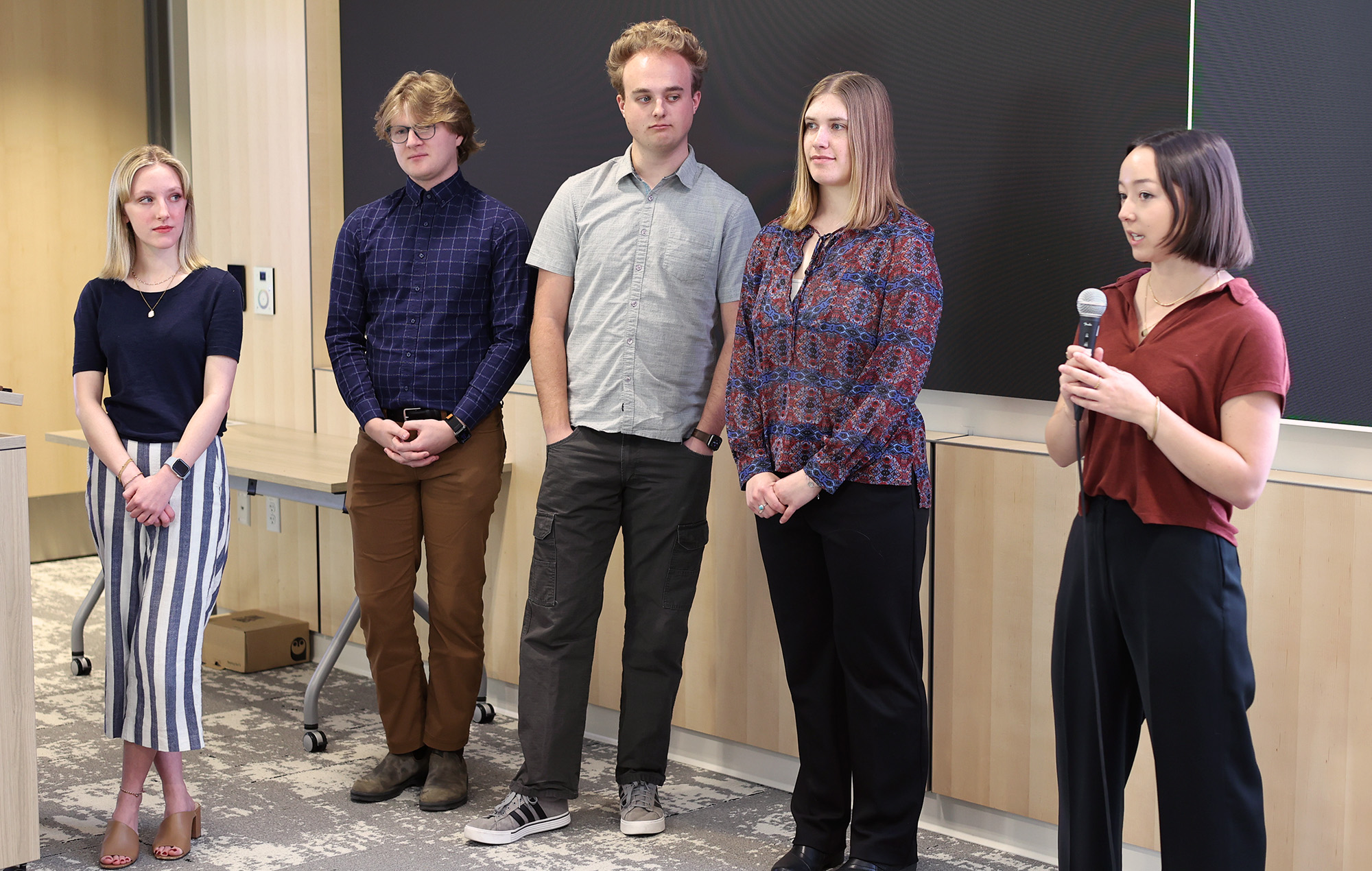
- Isabella DeBoer (undergraduate, computer science)
- Avery Hewitson (undergraduate, environmental and sustainability studies)
- Delia Leonard (undergraduate, computer science)
- Bode Packer (undergraduate, computer science)
- Jaxon Smith (undergraduate, computer science)
Slow Your Scroll is a proposed third-party app that tackles a hidden climate problem: wasted data from short-form video platforms. The team notes that about 60% of data downloaded to phones goes unused, largely due to infinite scroll and videos skipped within seconds. Because platforms like TikTok serve billions of users through energy-intensive data centers, even small reductions in unnecessary data transfer could translate into meaningful energy and emissions savings.
Their innovation combines three elements not currently unified into one tool: data-buffer minimization, screen-time management and environmental impact feedback. The app would limit preloaded media, interrupt scrolling with prompts, display energy saved and set usage caps. They argued existing screen-time apps with large user bases and proven data-saving functionalities prove their idea is feasible.
For implementation and scale, the team proposes a consumer-facing app targeting at least 50,000 users, projecting large aggregate energy savings, while advocating for broader, systemic adoption to ease infrastructure strain. By reducing demand on data centers, the solution aims to lower water and energy burdens on nearby communities.
Second place (tied) ($2,000)
Project: Turning Data Centers Into Community Assets
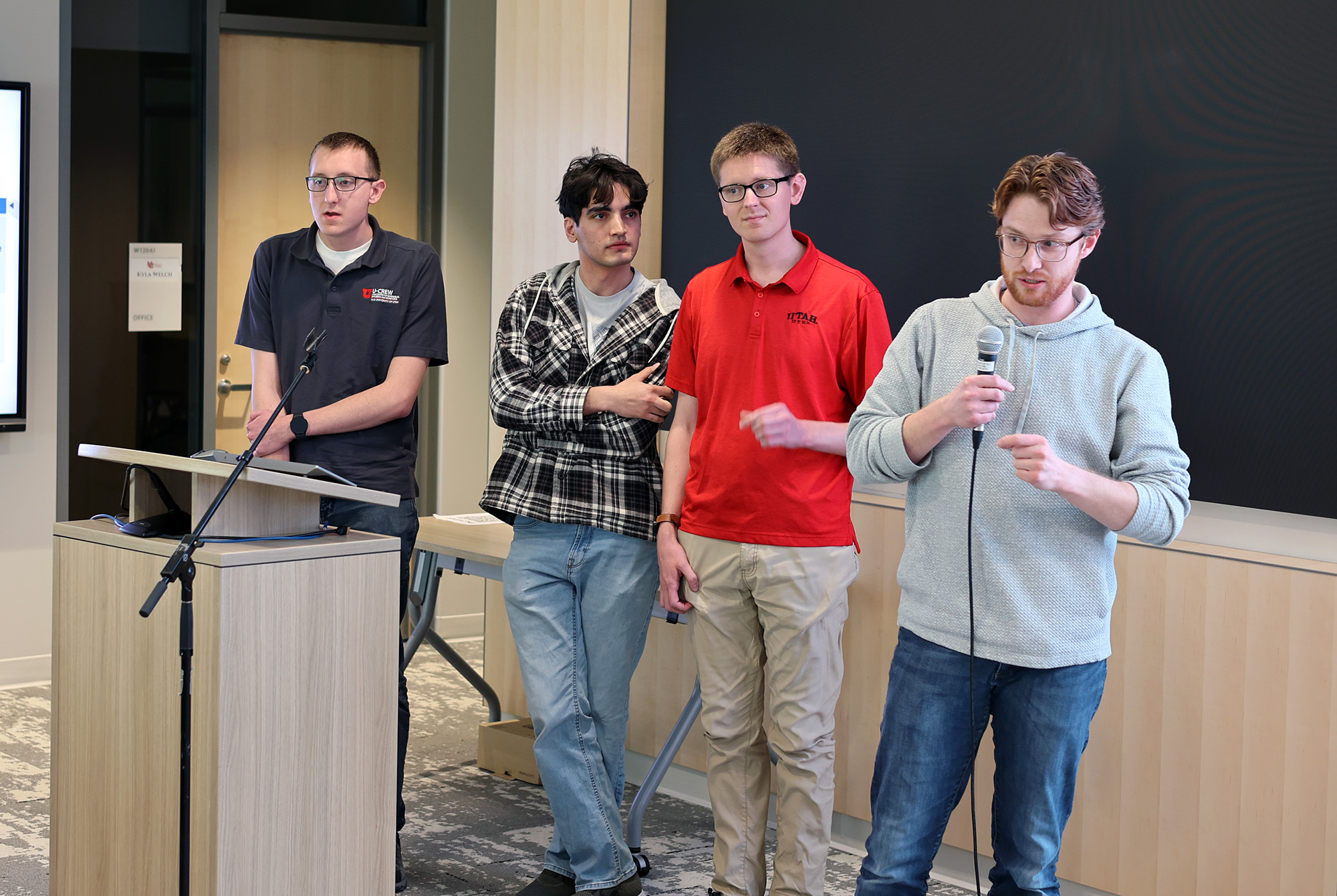
- Caleb Black (graduate, electrical and computer engineering)
- Micah Black (undergraduate, electrical engineering)
- Ethan Gallup (graduate, chemical engineering)
- Turan Mammadli (graduate, chemical engineering)
- Pouya Sheikhosseini (graduate, chemical engineering)
This team addressed a growing disconnect: data centers are expanding rapidly in Utah, but they operate as isolated, high-energy facilities rather than integrated community assets. As a result, communities miss opportunities to reuse waste heat, conserve water, stabilize grids and lower energy costs.
Their innovation reframes data centers as quasi-utilities. In urban areas, they propose capturing waste heat from a 10 MW data center and supplying it to nearby mixed-use developments through district heating, enabled by liquid-to-liquid heat exchangers and a heat purchase agreement. In rural towns, they propose “load shaping,” where a data center dynamically ramps power use up or down to flatten electricity demand, avoiding grid upgrades and reducing rates.
Feasibility rests on stacked financial incentives (e.g., WattSmart programs), cooperative utility contracts and existing policy mechanisms. In the urban case, incentives reduce payback from over 24 years to roughly three years, making projects financeable.
Implementation would begin with pilot integrations in both urban and rural Utah, using telemetry, smart-grid controls and formalized heat and power agreements. The model scales by leveraging existing utility programs and replicating contractual frameworks across municipalities.
Third place ($1,000)
VoltVault
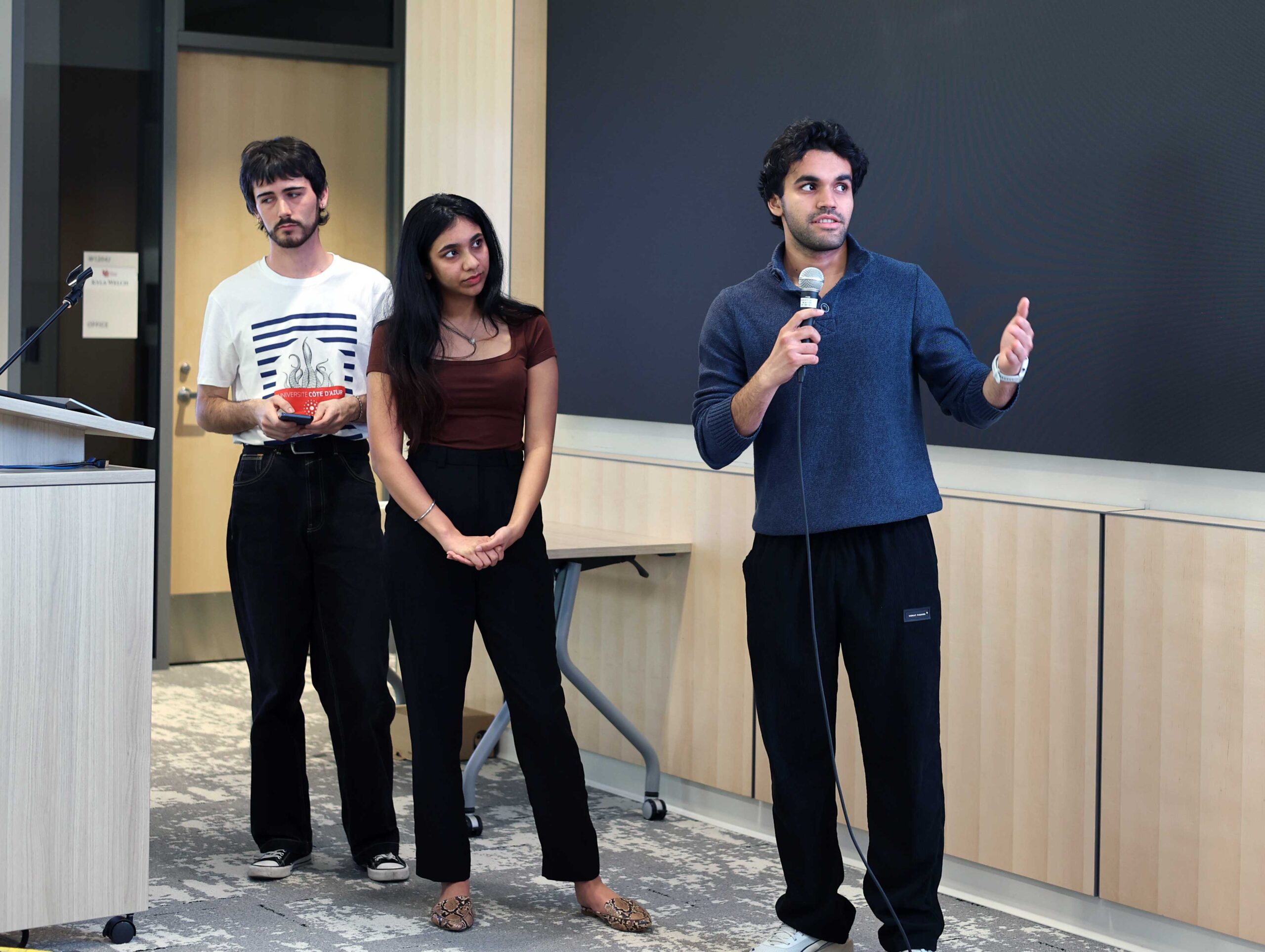
- Diya Mandot (undergrad, computer science)
- Rishabh Saini (undergrad, computer science)
- Raphael Meyer (graduate, geography – Université Côte d’Azur)
VoltVault addresses a costly flaw in today’s electricity system: demand spikes in the evening drive prices from roughly $30–50/MWh to as high as $200–500/MWh, forcing utilities to fire up expensive, high-polluting “peaker” gas plants. At the same time, millions of electric vehicles (EVs)—each with a large battery—sit parked 95% of the time.
VoltVault’s innovation is to turn these idle EVs into a distributed “virtual power plant.” Using brand-agnostic aggregation, AI-driven peak forecasting and real-time optimization, the platform coordinates thousands of vehicles to discharge small amounts of power (5–10 kW each) back to the grid during peak stress. Unlike hardware-specific pilot programs, VoltVault is a software coordination layer designed to scale from city to national levels.
The idea is technically feasible, as replacing a 100 MW gas peaker plant with a two-hour peak would require about 10,000 EVs—well within reach as EV adoption accelerates. But the solution would require a widely dispersed network of bi-directional chargers and EVs—something automakers are only recently rolling out.
Implementation would involve detecting grid stress, dispatching enrolled bi-directional chargers, aggregating distributed output to avoid peaker activation and compensating drivers through an app interface. As EV adoption grows, capacity scales automatically.
A more comprehensive analysis of the proposed solutions can be viewed here.