Banned Books Week, originally launched in 1982, celebrates the freedom and right to read. During the week-long celebration, members of the book community unite to raise awareness about censorship in public libraries, schools and bookstores. In honor of Banned Books Week, staff and faculty from the Marriott Library are sharing their favorite challenged and banned books. Here are 11 of their top picks.

“Two Boys Kissing”
By David Levithan
Selected by Jordan Hanzon, marketing and public relations associate
"Two Boys Kissing" was the 18th-most banned and challenged book in the United States between 2010 and 2019. Additionally, it topped the organization's top 10 list three times: 2015, 2016 and 2018, because of homosexual and sexually explicit content, as well as because it condones public displays of affection. It was one of the first books that really put in perspective for me how lucky we are and how far we've come thanks to those who came before us who fought and died for LGBTQIA+ rights. Definitely an important story to tell and remember.

“Maus”
By Art Spiegelman
Selected by Melanie Hawks, assistant dean for organizational development; director of library HR
Art Spiegelman’s Pulitzer Prize-winning "Maus" is credited with popularizing the graphic novel and has been used in public schools for decades to teach about the Holocaust. In 2023, a Tennessee school district banned it for depicting a naked female corpse, redefining the image as a “nude woman” and declaring it sexually explicit. In an interview with PEN America, Spiegelman responded, "anybody who could get their jollies off of 'Maus' is probably in need of far greater help than anything the school could offer…There’s nothing there that could possibly titillate.” The Tennessee ban set off a wave of subsequent bans in other states. Spiegelman's full PEN America interview is worth reading.
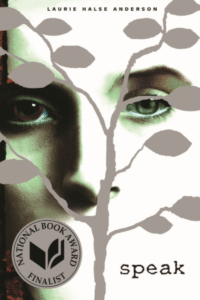
“Speak”
By Laurie Halse Anderson
Selected by Ambra Gagliardi, collection development librarian
Laurie Halse Anderson’s young adult novel "Speak," a finalist for the National Book Award and winner of the Golden Kite Award (amongst others), has appeared on the American Library Association’s list of most challenged books since its publication in 1999. In it, Anderson tells the story of high school freshman Melinda, who is raped at a party, is ostracized by her peers for contacting the police and eventually loses her voice. This book says all the things a physically abused young person can’t. A must-read for any gender. It was once required reading for many school-age children and is now among the most challenged and banned books ever.

“Lawn Boy”
By Johnathan Evison
Selected by Kaylee Alexander-Leunissen, research data librarian
Not only is it a great book (it's a semi-autobiographical coming-of-age story about a 20-something navigating his class, race and queer identity), but the reason it was banned is so ridiculous and a clear example of why people need to read the whole book—and make sure they're not conflating books with the same title by different authors for different age groups—before passing judgment on its contents. It was first challenged, I believe, in 2021; it also received an ALA Alex Award (for books written for adults with an appeal to young adults) in 2019.

“Lolita”
By Vladimir Nabokov
Selected by Lux Darkbloom, grad and undergrad services librarian
When writing "Lolita," Vladimir Nabokov challenged himself to the impossible: Tell a deeply disturbing story, but make its prose beautiful. He wanted to see if he could put his readers inside the mind of a predator and let them struggle through their own discomfort as they find themselves being manipulated by him. From the first page, the reader is to understand that Humbert is an unreliable narrator. He’s not the leading man in a romance; he’s an obsessed and delusional criminal. Over the years, Nabokov was forced to explain again and again that his own morality did not drive the story, that he never intended for Humbert to be a sympathetic or likable character. When "Lolita" was published in 1955, it was immediately banned in several countries and would continue to be throughout the 1960s. Nabokov was vehement that the book cover should never feature a young girl, but many publishers over the years would ignore his request.

“In the Night Kitchen”
By Maurice Sendak
Selected by Randy Silverman, head of preservation
Maurice Sendak is my favorite children’s author, and "In the Night Kitchen" is my favorite of all his children’s books. The piece was blacklisted many years ago for a scene depicting Mickey, the story’s protagonist, in the nude. A Caldecott Honor book, the story sparked debate about artistic expression and the role of literature in children’s emotional development. It is written with a wonderful, dreamlike cadence and remains an extremely poignant work.

“1984”
By George Orwell
Selected by Alison Fox, lending supervisor
"1984" is arguably the most well-known work of dystopian fiction in history. Publication was restricted in the Soviet Union during the Cold War, and in the 80s it was challenged in Florida for, among other things, being "pro-communist." But this book does not target any single ideology—it is a general critique of totalitarian rule. When I was a young adult, "1984" played an important role in shaping my morals by opening my eyes to the tactics used by authoritarian systems to maintain control, and it continues to influence me to this day.

“Lord of the Flies”
By William Golding
Selected by Grace Ujifusa, acquisitions assistant
"Lord of the Flies" is a piercingly sobering realization of a world without the constraints of humanity's expectations, which feels increasingly relevant as time passes. It brings to the spotlight humans' tendency to unravel when away from the pressures of onlookers, rules and a basis of moral standards, but it was originally banned in 1975, with continuous and current challenges "...call[ing] it 'demoralizing' for implying 'man is little more than an animal.'"

"The Giver"
By Lois Lowry
Selected by Brooke Christenson, science and engineering librarian
"The Giver" is such a beautiful exploration of what makes a good society, what it means to truly live and love and the ethics of being a human. The book was first challenged in 1994 due to violence, sexual content and more. I first read it when I was in fifth grade and it remains one of my all-time favorite books.

"The Perks of Being a Wallflower"
By Stephen Chbosky
Selected by Chloe Sparrow, marketing and communications specialist
"The Perks of Being a Wallflower" is one of the first books that I read when I began “reading for pleasure.” It follows Charlie, a freshman in high school who is shy, introspective and of course, a wallflower. Reading about Charlie deal with the realities of being a teen while I was a teenager myself was pivotal for me during that time of my life. Knowing that it was banned and challenged due to its mature, sensitive and realistic themes was mind-boggling to me. According to the ALA, Chbosky’s novel was the second most challenged book in 2025, moving up from its previously held spot as the third most challenged title in 2023.

"Leaves of Grass"
By Walt Whitman
Selected by MJ Todd, Answer U generalist
"Leaves of Grass" was banned throughout the late 19th century over its open discussion of sexuality and queer intimacy. Walt Whitman was not without his prejudices, but a lot of this book feels remarkably modern and loving. I’ve loved the book since I read it at 18 and still turn to it for connection and solace.